
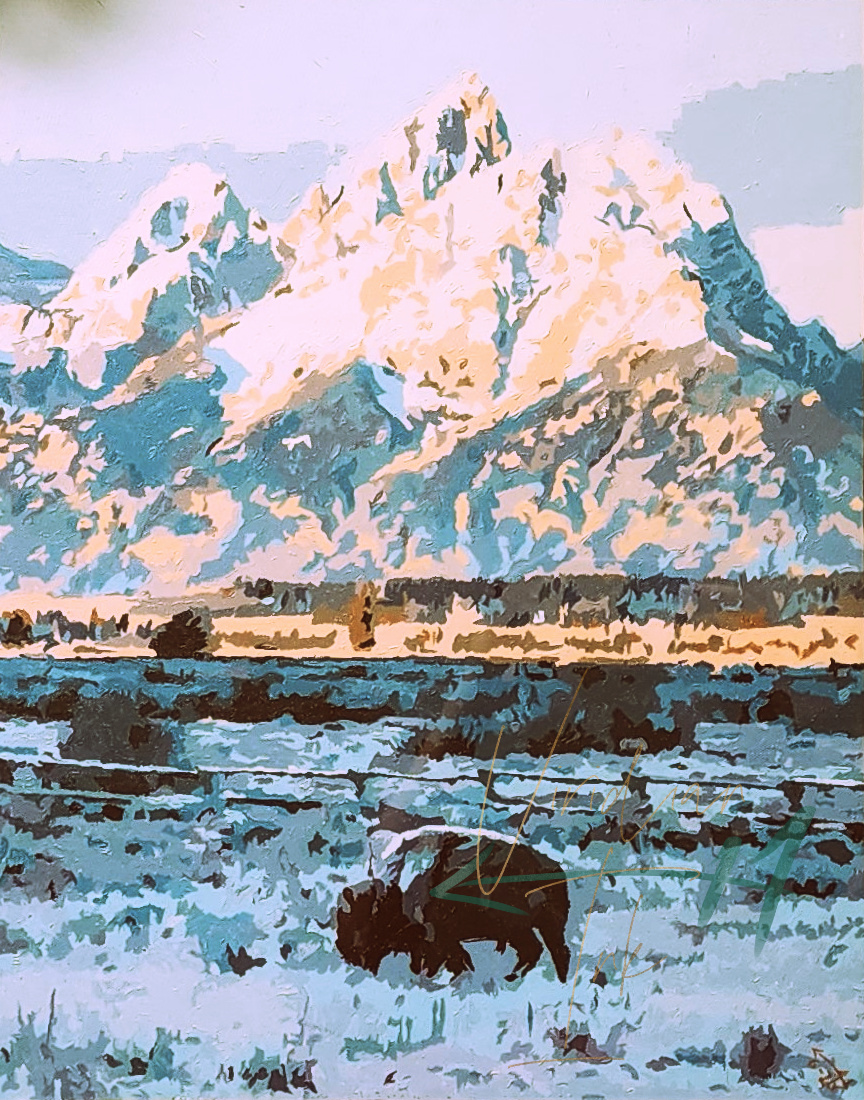
There is a stillness in the Tetons that speaks in the language of eternity. Snow crowns the mountains in pale fire, their sharp edges cut from the bones of the earth itself. Beneath them, in a world dwarfed by such grandeur, a solitary figure moves—massive, unhurried, and ancient as the land it treads.
The painting In the Shadows of Giants captures this quiet conversation between the monumental and the enduring. At first, your eyes are drawn upward, to the towering peaks washed in gold and blue, their presence so commanding they seem to hold the sky in place. But then, in the frozen meadow below, you find him: the bison.
He is not small. no creature of the plains ever truly is — but here, against the cathedral of stone, he becomes a humble pilgrim. His form is rendered in deep, earthen tones, each brushstroke carrying the weight of survival in a place where winter is both sculptor and judge.
This is not a scene of conquest or drama. It is a portrait of coexistence. of a creature that has walked these lands since before the first human story was told, standing now in the same shadow that has fallen for millennia. The air is cold enough to hold sound still. You can almost feel the rhythm of his breath, see the faint curl of it against the crisp horizon.
In the Shadows of Giants is more than landscape art. it is a meditation on scale and reverence. The Tetons rise unchallenged, and yet the bison does not bow. Instead, he carries his own history into their shade, a living testament to endurance and belonging.
Here, in the hush between the mountains and the plains, the giants stand watch, and the bison walks on—both keepers of a land that is as wild as it is eternal.
 Harlann Ashe - Viridian Ink
Leave a comment